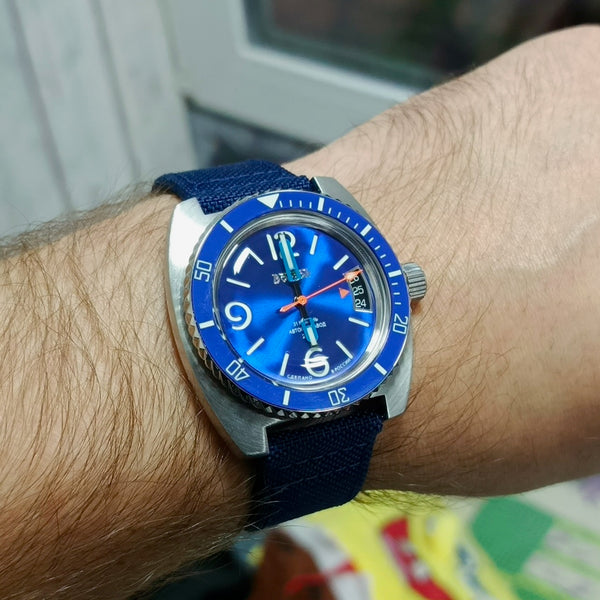
Water resistance in watches is one of the most important, but also one of the most frequently misunderstood topics when buying a watch. Terms such as splash-resistant, 3 ATM, 5 ATM, 10 ATM, 20 ATM, or 30 ATM may seem clear at first glance. In practice, however, these ratings are often misunderstood. Many buyers think that a watch with 100 m or 200 m water resistance can automatically be worn at exactly that depth under real-world conditions. In fact, these values refer to technical tests carried out under precisely defined conditions.
Anyone who wants to properly understand a watch's water resistance should therefore not just look at the number, but also at how this rating is determined and what kinds of stress a watch is actually exposed to in everyday life. This includes not only water and depth, but also temperature changes, water vapor, movement in the water, and above all pressure spikes, such as when jumping into the water. This particular point is often underestimated.
What does water resistance mean for watches, anyway?
When a watch is labeled water-resistant, water resistant, or marked with ratings such as 3 bar, 10 bar, or 200 m, this describes the case's resistance to water ingress. These values are determined according to technical standards and testing procedures. The watch is subjected to a specific pressure under controlled conditions.
The important point is that this test does not reflect every real-life use case exactly. In everyday life or during sports, a watch is exposed not only to uniform pressure but often to changing loads. Therefore, the water-resistance rating should always be understood as a technical classification—not as direct approval for every conceivable use in water.
Static and dynamic pressure—the crucial difference
To properly assess water resistance, it is important to understand the difference between static pressure and dynamic pressure. Static pressure is the uniform pressure acting on the case in a test situation or in still water. Typical ratings such as 3 ATM, 10 ATM, or 20 ATM are based precisely on such conditions.
Dynamic pressure, on the other hand, occurs in practice through movement and sudden loads. These include vigorous arm movements while swimming, a jet of water, plunging into the water with force, or a jump into the water. At such moments, brief pressure spikes can occur that are significantly higher than the pressure exerted by still water alone. That is precisely why a watch marked 30 m is not automatically suitable for active swimming or jumping into the water.
This is one of the main reasons why meter ratings on watches are often misunderstood. The number on the case or dial primarily refers to laboratory conditions with static pressure—not to every dynamic strain encountered in everyday use.
Splash-resistant—what does it mean?
The designation splash-resistant describes only basic protection against small amounts of moisture. Such watches generally withstand a few drops of water, light splashes, or a little rain. However, this rating is not intended for more substantial contact with water.
Splash-resistant explicitly does not mean that the watch is suitable for showering, bathing, swimming, or water sports. Even normal handwashing under running water can be borderline for such models, especially if the watch is older or its seals have already aged.
ATM, bar, and meters—how are these ratings related?
In the watch industry, water-resistance ratings are usually given in ATM, bar, or meters. For simplicity, these values can be considered approximately equivalent:
- 1 ATM corresponds to approximately 1 bar
- 10 ATM correspond to approximately 10 bar
- 10 bar correspond to approximately 100 meters of test pressure
- 20 bar correspond to approximately 200 meters of test pressure
- 30 bar correspond to approximately 300 meters of test pressure
This conversion is helpful, but it must not be confused with an actual usable diving depth. The meter rating is not a practical diving guideline, but a technical comparison value.
The individual water-resistance levels at a glance
Splash-resistant
This rating represents very basic protection against light moisture and occasional splashes. You should not expect more from a watch with this rating.
Suitable for: light moisture, occasional splashes, light rain
Not suitable for: washing your hands under running water, showering, bathing, swimming, jumping into water, diving
3 ATM / 3 bar / 30 m
A watch rated at 3 ATM is designed for normal everyday use with light contact with water. This includes rain, splashes, or careful handwashing. This level is not intended for activities in the water.
Suitable for: everyday use, rain, splashes, careful handwashing
Not suitable for: showering, bathing, swimming, jumping into water, water sports
Especially with 3 ATM, you should bear in mind that even dynamic loads can be problematic. Jumping into water or vigorous movement in a wet environment can create pressure spikes for which this rating does not offer sufficient reserve.
5 ATM / 5 bar / 50 m
With 5 ATM, a watch is better protected in everyday use than one rated at 3 ATM. It is suitable for more frequent contact with water, such as when washing your hands or in the rain. Nevertheless, this level should not be understood as genuine approval for swimming or sports activities.
Suitable for: everyday use, rain, handwashing, heavier contact with water
Suitable to a limited extent for: brief rinsing
Not ideal for: showering, prolonged bathing, regular swimming, jumping into water
The same applies here: the technical test rating says little about how well the watch withstands dynamic loads. In particular, pressure spikes caused by movement or impact with the surface of the water can be more critical than calm water.
10 ATM / 10 bar / 100 m
A watch rated at 10 ATM is significantly more robust and, for many users, the first sensible level when the watch regularly comes into contact with water. As a rule, it is well suited to swimming and many recreational activities in the water.
Suitable for: swimming, recreational activities in the water, many outdoor activities
Depending on the model, suitable for: snorkeling
Not automatically suitable for: demanding diving, heavy impacts with water, or extreme pressure loads
Even at 10 ATM, you should understand that a jump into the water places different stress on a watch than calm swimming. Dynamic pressure can briefly be significantly higher than the static test pressure in a laboratory. For normal water use, 10 ATM is usually sufficient, but caution is advisable under particularly demanding conditions.
20 ATM / 20 bar / 200 m
Watches with 20 ATM or 200 m water resistance belong to the category of rugged sports and dive watches. This class is very well suited to swimming, snorkeling, and intensive water use. Many mechanical dive watches with a screw-down crown fall within precisely this range.
Suitable for: swimming, snorkeling, frequent water contact, sports use
Important: the crown and case must be fully sealed and in good technical condition
Here too, dynamic stresses play a role. Although 20 ATM provides a high safety reserve, a watch at this level should still not be treated carelessly. Jumping into the water, strong impacts, or operating the crown while wet are all things that should be avoided.
30 ATM / 30 bar / 300 m
A watch with 30 ATM or 300 m water resistance offers an even greater reserve and is typical of particularly rugged dive watches. This level is of interest to users seeking maximum water resistance and high durability.
Suitable for: intensive water use, swimming, snorkeling, very rugged use
Depending on the design, suitable for: more demanding diving
Important: regular water-resistance testing remains advisable even at 30 ATM
Despite its high water resistance, even 30 ATM does not replace careful handling. Dynamic pressure, impacts, and aging seals remain factors that affect actual safety.
Showering with a watch – why it is often not a good idea
Many watch owners wonder whether they can wear a water-resistant watch while showering. In practice, this is usually not a good idea. The problem is not just the water itself, but especially the combination of heat, water vapor, temperature changes, and soap or shampoo. Over time, these factors can put greater strain on seals and materials than cold or lukewarm water.
That is why the sensible recommendation is: Avoid wearing watches in the shower whenever possible — even if they are rated at 10 ATM, 20 ATM, or 30 ATM. Technically, some may work in the short term, but taking the watch off is the gentler solution in the long run.
Practical table: Which water resistance rating is suitable for what?
| Water resistance | Meaning | Typical use |
|---|---|---|
| Splash-resistant | Only light protection against moisture | Light rain, occasional splashes of water |
| 3 ATM / 30 m | Basic everyday protection | Rain, splashes, careful hand washing |
| 5 ATM / 50 m | Greater everyday protection | Regular contact with water in everyday life |
| 10 ATM / 100 m | Suitable for active use | Swimming, leisure time in the water |
| 20 ATM / 200 m | Very high water resistance | Swimming, snorkeling, sporting activities in the water |
| 30 ATM / 300 m | High reserve for demanding use | rugged dive watch, intensive water use |
Why the meter rating is often misunderstood
The most common misconception is: 30 m = a diving depth of 30 meters. That is not correct. The values refer to laboratory conditions with static pressure. In everyday use, however, additional loads arise, especially from dynamic pressure. Even vigorous swimming movements or jumping into the water can create different pressure conditions than calm immersion.
That is precisely why a watch rated for 30 m water resistance is not intended for swimming. Higher ratings such as 100 m, 200 m, or 300 m provide significantly greater reserves, which are useful for sports or activities in and around water.
What should you bear in mind with water-resistant watches?
Even a water-resistant watch will remain reliably sealed only if it is in good technical condition. Seals age, crowns can loosen, and cases can show wear over time. Therefore, not only the original factory rating matters, but also the watch’s current condition.
- Always close the crown completely: This is especially important with screw-down crowns.
- Never operate the crown or pushers underwater: Otherwise, water may enter the case.
- Rinse with fresh water after contact with salt water: This protects the case, seals, and strap.
- Do not take the watch into the shower: Heat, steam, and soap can cause problems over time.
- Avoid strong pressure spikes: For example, caused by hard jumps into the water or unnecessary impacts.
- Have water resistance checked regularly: Especially for older watches, sports watches, and mechanical models.
Particularly important for mechanical and automatic watches
For automatic watches and other mechanical watches, actual water resistance depends not only on the specification in the data sheet, but also on the condition of the seals, crown, and case. A watch may originally be designed for 20 ATM or 30 ATM—but if the seals have aged or the crown has not been screwed down correctly, its protection decreases significantly.
Robust dive watches and Russian automatic watches with a screw-down crown in particular offer structural advantages. Nevertheless, even good construction does not replace regular inspection and careful handling in everyday use.
What level of water resistance is suitable for which use?
Anyone who wears their watch only in everyday situations or at the office can often make do with splash resistance, 3 ATM, or 5 ATM. If you want to swim, you should opt for 10 ATM or more. For users looking for a robust sports or dive watch, 20 ATM or 30 ATM are the more sensible classes, as they offer significantly greater reserves against real-world stresses and dynamic pressure spikes.
Conclusion: Understanding water resistance in watches correctly
Anyone looking to buy a watch should always read the specifications for water resistance realistically. Splash-resistant means only basic protection, 3 ATM is suitable for light everyday use, 5 ATM offers greater everyday security, 10 ATM is usually a good choice for swimming, 20 ATM indicates genuinely robust water resistance, and 30 ATM provides substantial reserves for demanding use.
However, what matters is not only the number, but also an understanding of static and dynamic pressure. A watch is not subjected only to uniform loads in everyday life, but often also to movement, jumping into water, temperature changes, and water vapor. Knowing these differences helps you choose the right watch more consciously and enjoy your wristwatch for longer.